
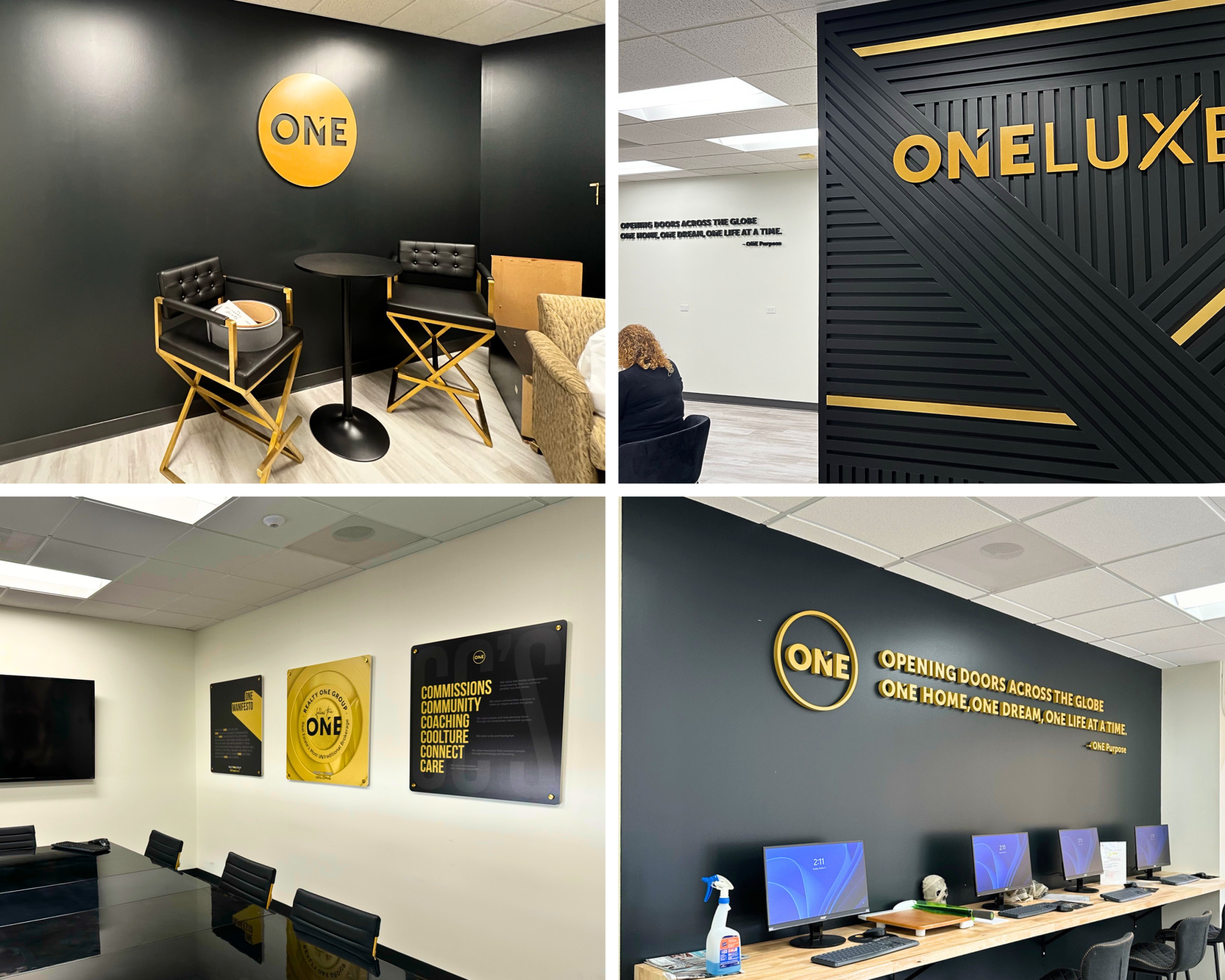
Corporate headquarters rarely struggle with brand recognition. More often, they struggle with consistency.
As facilities expand, departments relocate, and teams grow, signage standards can quickly become fragmented. Different materials, inconsistent naming conventions, outdated branding, and disconnected wayfinding systems create confusion for visitors and employees while increasing long-term maintenance costs.
At VizComm Signage Group, we’ve spent years helping Orange County organizations develop signage systems that support both operational efficiency and brand consistency. In our experience, the most successful headquarters environments treat signage as a strategic business asset rather than a collection of individual signs.
These office signage guidelines for corporate headquarters will help you create a scalable signage framework that supports branding, navigation, compliance, and future growth while reducing the burden on your facilities team.
Quick Office Signage Design Standards Checklist
Before implementing your office project, confirm these essentials:
- Define a Master Design concept and work with internal sub-committees on their ideas of what “feel” you want the office to have. If you do not have a team to support this, a competent sign company can work to support your vision with real work, past projects that can be shared to showcase these best practices and sign builds.
- As there are so many options in signage, determine what is important.
- Exterior signage– overhead signs, monuments, wayfinding, safety signage
- Interior signage– lobby signs, wall murals (decorative or branding oriented), ADA signage, wayfinding, privacy frost for glass, warehousing signage, floor graphics
- Standardize materials, finishes, and typography
- Implement modular signage systems for flexibility in the future
- Establish ADA-compliant color contrast rules
- Create naming conventions for buildings and departments
- Align signage with Orange County and or City zoning requirements
This checklist ensures your office signage design standards are scalable, compliant, and easy to maintain.
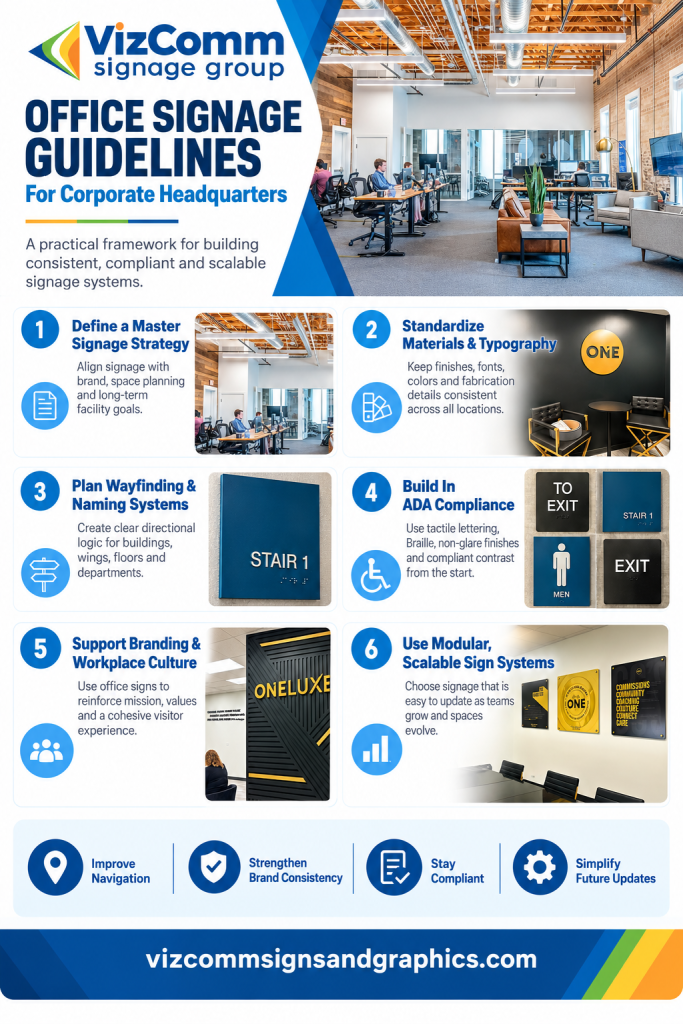
Here’s a visual overview of the core signage standards corporate headquarters should establish to maintain consistency, accessibility and long-term scalability.
What Are Office Signage Guidelines for Corporate Headquarters?
Office signage guidelines for corporate headquarters are documented standards that govern how signs are designed, fabricated, installed, maintained, and updated throughout a corporate environment.
These standards help ensure every employee, visitor, vendor, and stakeholder experiences the same level of professionalism regardless of where they are within the facility.
Strong corporate office signage guidelines typically address:
- Branding standards
- Typography and color usage
- Naming conventions
- Wayfinding systems
- Accessibility requirements
- Material specifications
- Digital signage integration
- Maintenance procedures
- Future expansion planning
More importantly, they prevent departments from making isolated signage decisions that slowly weaken brand consistency over time.
When properly implemented, signage standards improve navigation, reduce maintenance costs, strengthen workplace branding, simplify future updates, and support long-term organizational growth.
Empowering Teams Through Corporate Interior Signage Planning
Corporate churn is a reality. Departments shift, executives relocate, and facilities constantly expand. Signage should stay consistent and flex with these changes. If a visual system relies on permanent, direct-to-drywall room identification, maintenance budgets will skyrocket.
The most critical component of modern workplace interior signage design is modularity. An internal manual should explicitly mandate modular architectural track systems with interchangeable naming instead of permanent adhesives that require the whole sign to change. This simple standard allows a facilities team to swap out a nameplate in thirty seconds for pennies.
Modularity drastically reduces long-term maintenance costs and ensures the facility remains visually pristine. Facilities directors can consistently update professional interior office signage without hiring a contractor to patch and repaint damaged drywall.
Furthermore, when planning office lobby and reception signs, planners should define exactly which substrates are authorized for indoor use. Guidelines for materials to be used in corporate facilities should list approved materials. This will ensure that office locations in the future will look harmonious and consistent, better supporting the brand.
Navigating ADA Signage For Offices and Wayfinding Logistics
A visual system is completely useless if it fails to meet life-safety codes.
Internal documentation must integrate rigorous workplace wayfinding signage systems to protect the organization from costly compliance lawsuits.
Facilities directors frequently ask: Can custom brand colors be used for ADA restroom identification markers? Yes, provided they meet the strict contrast requirements set by federal and state laws.
The California Building Code (Chapter 11B) requires strict light-on-dark or dark-on-light contrast ratios for all tactile environmental graphic elements.
If the primary corporate colors are two mid-tones, like medium blue and slate gray, they will fail a Certified Access Specialist (CASp) inspection if used together.
The corporate manual must establish an approved secondary color palette specifically designated for custom office signs for businesses that require tactile braille. Additionally, California Title 24 requires a strict non-glare finish. The guidelines must explicitly ban the use of highly reflective metals or glossy acrylics for any required life-safety touchpoints.
Frequently Asked Questions About Corporate Office Signage Standards
Implementing a comprehensive system across a sprawling campus naturally raises operational questions. Here are the common inquiries facilities managers face when deploying corporate office signage systems locally:
How do organizations maintain brand identity without making the space feel like an advertisement?
This is achieved through strict visual hierarchy. Guidelines should restrict the usage of the full corporate logo to primary reception areas. For secondary touchpoints, utilize the brand’s primary typography and color palette without repeating the actual logo to prevent visual fatigue.
What is the best way to name wings and floors?
A massive headquarters requires a standardized naming convention. Flawless office wayfinding signage design must dictate exactly how buildings and floors are named so directional logic remains consistent from the parking garage to the boardroom.
Can digital signage be included in signage standards?
Absolutely. Modern headquarters increasingly rely on digital directories, visitor management systems, meeting room displays, and interactive navigation tools that should align with overall signage standards.
What should be included in a corporate signage standards manual?
A comprehensive manual should include branding standards, typography requirements, approved materials, ADA guidelines, wayfinding systems, naming conventions, digital signage standards, and maintenance procedures.
How Successful Corporate Headquarters Maintain Signage Consistency During Growth
The organizations that maintain the strongest brand presence rarely rely on one-time signage projects. Instead, they establish governance standards that guide future decisions.
Successful facilities typically document approved materials, typography, naming conventions, accessibility requirements, directional systems, digital signage standards, and replacement procedures. This creates consistency even as departments expand, facilities evolve, and leadership changes.
We’ve seen firsthand how documented signage programs help organizations avoid unnecessary replacement costs while maintaining a cohesive workplace experience across every touchpoint.
Why Corporate Headquarters Partner With VizComm Signage Group
Developing a headquarters signage program requires more than selecting materials and installing signs. Organizations need a partner who understands branding, compliance, facility operations, permitting requirements, fabrication logistics, and long-term scalability.
Our team brings together decades of signage production experience and more than 25 years of combined marketing and visual communications expertise. That perspective allows us to look beyond the sign itself and focus on the business objectives behind it. Whether the goal is improving visitor navigation, strengthening brand consistency, supporting workplace culture, or simplifying facility management, we help organizations identify solutions that align with both operational needs and budget realities.
VizComm Signage Group understands local permitting requirements, city review processes, workplace environments, and the practical challenges facilities managers face every day. From permitting coordination and fabrication planning to installation scheduling, our goal is simple: be the signage partner that’s easy to do business with.
Also Read: From Boring to Beautiful: Revamp Your Office Space with Wall Murals
Execute Your Office Signage Design Orange County Strategy Without Complexity
Partner with the local experts who manufacture with absolute precision. VizComm Signage Group guarantees a seamless installation process with zero operational disruption, ensuring the office signage guidelines for your corporate headquarters are implemented flawlessly.
Signage designed to elevate your brand starts with a conversation. Reach out to VizComm Signage Group today to discuss your project with a local team committed to helping your organization succeed.